Functional Mushrooms Guide: Reishi, Cordyceps, Chaga & Turkey Tail
Evidence-based comparison of reishi, cordyceps, chaga, and turkey tail mushrooms. Covers benefits, mechanisms, dosage, quality markers, and how to choose supplements.
The bottom line: Four functional mushrooms beyond Lion's Mane, each with distinct evidence bases: Cordyceps for athletic performance (moderate evidence), Turkey Tail for immune support including cancer adjunct protocols (moderate), Reishi for immune modulation and mild calming (limited-moderate), and Chaga for antioxidant support (preliminary). Mushroom quality depends on fruiting body vs. mycelium-on-grain and beta-glucan content — cheap products are mostly starch.
At a Glance
This table scrolls horizontally on small screens. Use Tab to focus the table region, then scroll with arrow keys or touch.
| Mushroom | Best for | Evidence | Typical dose | Key active compounds |
|---|---|---|---|---|
| Cordyceps | Athletic performance, VO₂ max, energy | Moderate | 1,000–3,000 mg/day | Cordycepin, adenosine — increases ATP production |
| Turkey Tail | Immune stimulation; cancer adjunct (Japan-approved drug PSK) | Moderate | 2,000–3,000 mg/day | PSK/PSP polysaccharides — NK cell and T-cell activation |
| Reishi | Immune modulation, mild calming, stress resilience | Limited-moderate | 1,500–3,000 mg/day | Triterpenes (ganoderic acids) + beta-glucans |
| Chaga | Antioxidant support, general wellness | Preliminary | 1,000–2,000 mg/day | Betulinic acid, melanin — highest ORAC antioxidant score |
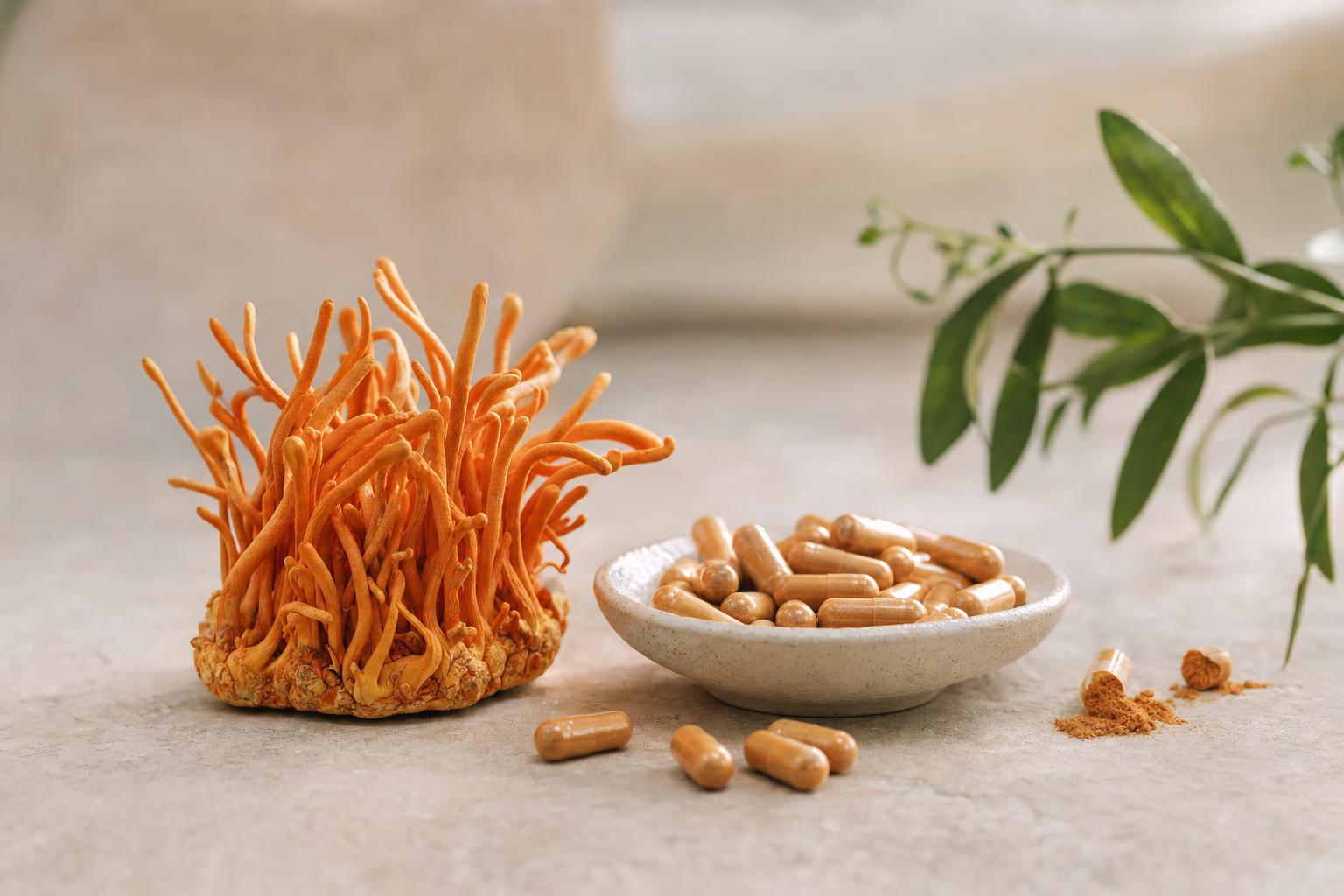
Cordyceps (Cordyceps militaris)
The performance mushroom. Multiple human trials show improved VO₂ max, exercise time to exhaustion, and oxygen utilization — making it the most evidence-backed functional mushroom for athletic performance. It's stimulating but not like caffeine — more like improved physical capacity at a given effort level.
Mechanism: Cordycepin and adenosine increase ATP production and improve oxygen utilization efficiency. This is not a stimulant — it's metabolic support that translates to better endurance and faster recovery.
Dose: 1,000–3,000 mg/day, 30–60 minutes before exercise. Look for Cordyceps militaris (cultivated) — wild C. sinensis is endangered and prohibitively expensive ($20,000+/kg). Cultivated C. militaris has comparable cordycepin content at a fraction of the cost.
Evidence: Systematic reviews consistently show improved VO₂ max (3–8% in trained athletes), increased time to exhaustion, and reduced markers of exercise-induced oxidative stress. Effect sizes are modest but real.
Turkey Tail (Trametes versicolor)
The most clinically studied medicinal mushroom for immune stimulation — and the only one with an approved drug status (in Japan). PSK (polysaccharide-Krestin) is a protein-bound polysaccharide extracted from Turkey Tail and approved as a cancer adjunct in Japan since the 1980s, used alongside chemotherapy to improve survival in gastric and colorectal cancers.
Mechanism: PSK and PSP (polysaccharopeptide) stimulate natural killer (NK) cells, T-cells, and dendritic cells — the innate immune system's first responders. This is immune stimulation, not modulation — relevant for immunosuppressed states (chemotherapy) but potentially problematic for autoimmune conditions.
Dose: 2,000–3,000 mg/day of hot-water-extracted powder standardized for polysaccharides. The approved PSK dose in Japan is 3 g/day.
Evidence: Multiple meta-analyses and RCTs in cancer patients show improved survival when PSK is added to chemotherapy. General immune support evidence (for healthy people) is weaker — Turkey Tail's strength is in clinical oncology, not wellness.
Reishi (Ganoderma lucidum)
The "mushroom of immortality" — mildly calming with immune-modulating effects. Some users report better sleep quality and reduced stress, but the evidence for sleep is preliminary. The immune modulation evidence is stronger: triterpenes (ganoderic acids) shift immune function toward a more balanced state rather than stimulating or suppressing.
Mechanism: Triterpenes modulate NF-κB and cytokine production. Beta-glucans provide general immune support shared across mushrooms. The calming effect may be related to triterpene interactions with GABA receptors, but this is not well-characterized.
Dose: 1,500–3,000 mg/day of dual-extracted (hot water + alcohol) fruiting body powder. Hot water extracts beta-glucans; alcohol extracts triterpenes. Single-extraction products miss one compound class.
Evidence: Meta-analyses show improved quality of life and immune markers in cancer patients. Sleep and anxiety evidence is limited to small trials and traditional use. Expect subtle effects — Reishi is not a sedative.
Chaga (Inonotus obliquus)
A woody conk that grows on birch trees, with the highest ORAC (antioxidant) score of any natural food tested. Betulinic acid (absorbed from the birch host tree) and melanin provide potent free radical scavenging.
Dose: 1,000–2,000 mg/day of dual-extracted powder.
Evidence caveat: Human evidence for Chaga is almost entirely epidemiological and preclinical. The antioxidant activity is well-characterized in vitro, but human clinical outcomes are very limited. Use as a general wellness support, not for a specific condition.
Sustainability note: Chaga grows slowly on living birch trees — overharvesting is a real ecological concern. Look for suppliers that practice sustainable harvesting or cultivation.
How to Choose Quality Mushroom Products
This table scrolls horizontally on small screens. Use Tab to focus the table region, then scroll with arrow keys or touch.
| Quality marker | What to look for | Red flag |
|---|---|---|
| Source material | "Fruiting body" clearly stated | "Mycelium on grain" or "myceliated grain" — mostly starch |
| Beta-glucan content | Tested and disclosed (>20% is quality) | "Polysaccharides" without beta-glucan specification |
| Extraction method | Hot water (beta-glucans) + alcohol (triterpenes) for Reishi and Chaga | Single extraction for triterpene-containing mushrooms |
| Third-party testing | Heavy metals, contaminants, identity verified | No testing — mushrooms bioaccumulate heavy metals |
FAQ
Which mushroom should I start with? Cordyceps for performance/energy, Lion's Mane for cognition, Turkey Tail for immune support, Reishi for calming. Match the mushroom to your goal.
Can I take multiple mushrooms together? Yes — they have non-overlapping mechanisms and are commonly stacked. Start with one to assess individual response.
Why are some mushroom supplements so cheap? Mycelium grown on grain is mostly starch from the grain substrate — it's cheap because you're buying grain, not mushroom. Quality fruiting body extracts cost more.
Related Articles
References
- Hirsch KR, Smith-Ryan AE, Roelofs EJ, Trexler ET, Mock MG Cordyceps militaris Improves Tolerance to High-Intensity Exercise After Acute and Chronic Supplementation (2016) — Source
- Oba K, Teramukai S, Kobayashi M, Matsui T, Kodera Y, Sakamoto J Efficacy of adjuvant immunochemotherapy with polysaccharide K for patients with curative resections of gastric cancer (2007) — Source
- Jin X, Ruiz Beguerie J, Sze DM, Chan GC Ganoderma lucidum (Reishi mushroom) for cancer treatment (2016) — Source
- Tee Yon Ern P, Tang YQ, Fung SY, Chia AY Therapeutic properties of Inonotus obliquus (Chaga mushroom): A review (2023) — Source