NOW Foods
NOW Turmeric 400 mg
Budget product example for basic turmeric root capsules; best used with black pepper for absorption.
Selection criteria
- • Budget pick for basic turmeric root capsules; best used with black pepper for absorption.
Educational Comparison
These three are the most studied natural options for inflammatory and joint discomfort, and they work through different routes. Curcumin broadly dampens inflammatory signaling (NF-κB, COX-2). Boswellia targets the 5-LOX/leukotriene pathway that curcumin largely misses. Omega-3 (EPA/DHA) shifts your baseline lipid balance toward resolving inflammation over the longer term. None is a painkiller in the pharmaceutical sense — each works on a days-to-weeks timeline.
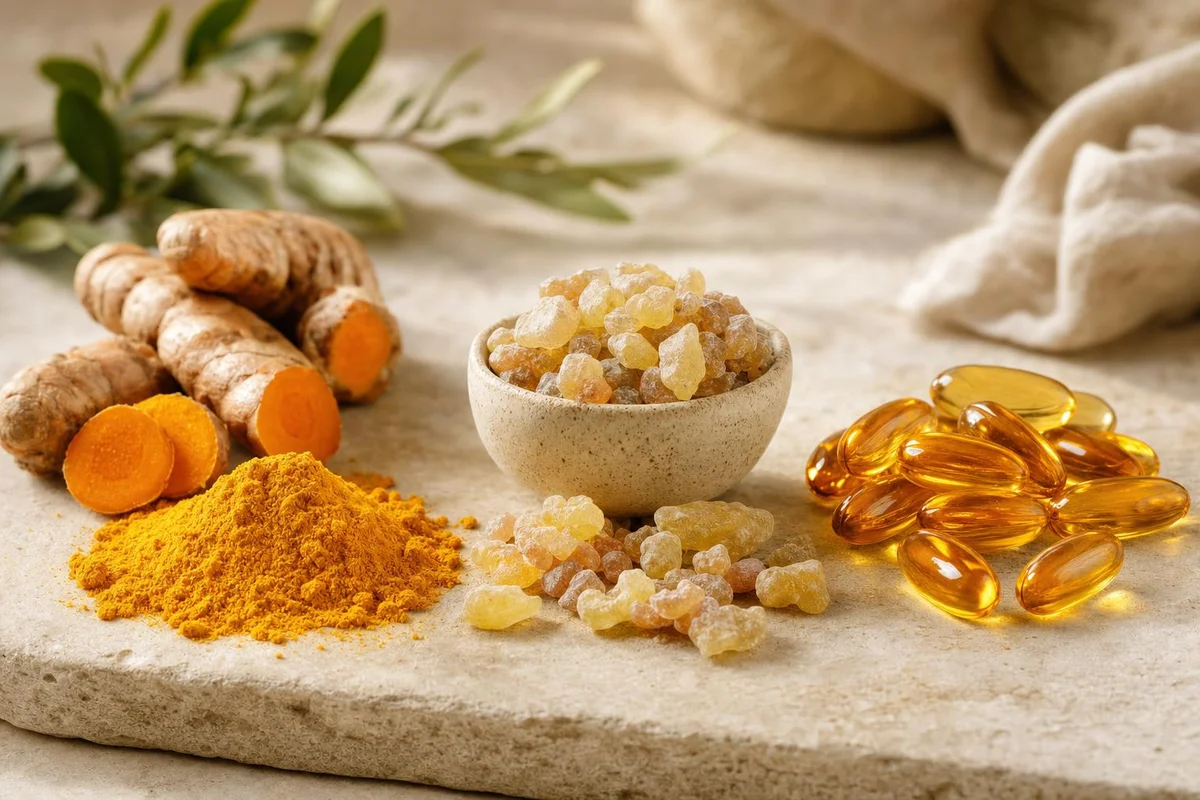
Curcumin has the strongest human trial evidence for inflammatory joint discomfort but needs a bioavailability-enhanced form (phytosome or piperine-paired). Boswellia works through a different pathway (5-LOX/AKBA) and tends to show the fastest subjective onset. Omega-3 is the slowest-acting of the three but supports systemic, whole-body inflammation over a 2-month-plus horizon. Because curcumin and boswellia hit different mechanisms, they are commonly stacked together.
Sources for this answer
Broad Anti-Inflammatory
Best for inflammatory joint discomfort with the strongest human trial base of the three. Absorption is poor on its own — look for bioavailability-enhanced forms (phytosome, or paired with piperine). Typically reviewed over 1–4 weeks.
5-LOX Pathway
Best for knee and mobility-related joint pain. Its boswellic acids (notably AKBA) inhibit the 5-lipoxygenase pathway, a different inflammatory route than curcumin — which is why the two are often stacked. Look for AKBA-standardized extracts.
Baseline Lipid Shift
Best for systemic, low-grade inflammation tied to an inflammatory dietary pattern. It works slowly by changing the raw materials your body uses to build inflammatory and pro-resolving signals. The longest timeline of the three (weeks to months).
Decision Table
| Factor | Curcumin | Boswellia | Omega-3 (EPA/DHA) |
|---|---|---|---|
| Primary Fit | Inflammatory joint discomfort, broad inflammatory load | Knee and mobility-related joint pain | Systemic low-grade inflammation, dietary imbalance |
| Onset Speed | 1 to 4 weeks | Days to 2 weeks | 2 to 8 weeks (or longer) |
| Primary Mechanism | NF-κB and COX-2 down-regulation | 5-LOX / leukotriene inhibition (AKBA) | EPA/DHA shift toward pro-resolving mediators |
| Evidence Grade | Moderate to Strong (OA) | Moderate | Moderate |
| Main Cautions | Anticoagulants, gallbladder disease, reflux sensitivity | Pregnancy, resin hypersensitivity, brand variability | Bleeding disorders, anticoagulants, peri-surgical periods |
| Bottom Line | Best-evidenced starting point for joint inflammation | Best for a different pathway — strong stack partner | Best foundational, whole-body inflammatory support |
Scenario 1
If your discomfort is clearly joint-centered with an inflammatory component, curcuminhas the most supportive human trial data, much of it in osteoarthritis-adjacent pain. Choose a bioavailability-enhanced form — plain turmeric powder is poorly absorbed and unlikely to reach studied levels.
Scenario 2
If curcumin alone has plateaued, boswellia targets the separate 5-LOX leukotriene route. Because the mechanisms differ, the two are frequently combined — but add one at a time so you can tell which is actually helping before stacking.
Scenario 3
If your inflammation is systemic and lifestyle-linked rather than one painful joint, omega-3 is the foundational play. Expect a slow build — it changes baseline lipid chemistry over weeks, so judge it on a 2-month horizon, not by day-three relief.
Safety & Clinical Cautions
All three carry a shared bleeding-risk theme. This matters most if you take anticoagulants or have surgery coming up:
Stacking all three compounds the bleeding caution. Review interactions on the safety checker and with a qualified clinician before combining.
FAQ
Yes — because they hit different inflammatory pathways (COX-2/NF-κB vs 5-LOX), they are a common and rational pairing, and some products combine them. Add them one at a time so you can judge each one's effect, and review the combined bleeding caution if you take anticoagulants.
Curcumin is poorly absorbed on its own. Most positive trials use bioavailability-enhanced forms (phytosome/Meriva, or curcumin paired with piperine). Culinary turmeric delivers far less curcumin than the studied doses, so it is unlikely to reproduce trial results.
Boswellia tends to show the quickest subjective change (days to ~2 weeks), curcumin over 1–4 weeks, and omega-3 the slowest (weeks to months) because it works by shifting baseline lipid chemistry rather than acutely blocking an enzyme.
Free safety checklist
Download our evidence-first guide to curcumin absorption forms, AKBA-standardized boswellia, omega-3 dosing, and the bleeding-risk checklist for stacking them. Pick a curcumin that actually absorbs: phytosome vs piperine • Read a boswellia label: why AKBA standardization matters • Anticoagulant and pre-surgery safety limits for all three
We use your email to send the checklist and occasional evidence-first supplement updates. Unsubscribe anytime. Privacy policy.
Dig deeper into mechanisms, dosage forms, and the full decision guides.
Compound
Broad NF-κB/COX-2 anti-inflammatory with the strongest human trial base — absorption is everything.
Compound
5-LOX leukotriene inhibitor (AKBA). A different pathway and a natural stack partner for curcumin.
Compound
Foundational lipid-balance support that shifts baseline inflammation over weeks to months.
Guide
The full decision guide comparing pain options by mechanism, onset, and risk.
Guide
Compare inflammation options by evidence grade, timing, and safety boundaries.
Some pages may include affiliate links. If you buy through those links, The Hippie Scientist may earn a commission at no additional cost to you. Affiliate relationships do not change evidence ratings, safety warnings, product-quality criteria, or editorial conclusions.
Read our affiliate and editorial policySourcing options
Affiliate recommended options selected by editorial standards. Review absorption form, AKBA standardization, and bleeding-risk warnings first.
Affiliate disclosure: we may earn a commission from qualifying links at no extra cost to you. How we stay independent.
Source ledger
6 sources