Affiliate disclosure: we may earn a commission from qualifying links at no extra cost to you. How we stay independent.
Pillar Guide · Rhodiola Hub
Rhodiola: The Complete Guide
Forms, Benefits, Dosing & What the Research Actually Shows
72% of American adults report experiencing fatigue regularly, and most reach for stimulants. Rhodiola offers a fundamentally different approach: as an adaptogen, it helps the body adapt to stress rather than simply stimulating or sedating. This guide covers what rhodiola is, why form matters more than for most herbs, what the evidence supports, and how to dose it correctly — no hype, no filler.
Quick Summary
Mental fatigue / burnout
- Best Form
- SHR-5 extract
- Dose
- 300–400 mg/day
- Timeline
- 2–3 weeks
Budget / whole herb
- Best Form
- Root powder
- Dose
- 1–2 g/day
- Timeline
- 2–3 weeks
Fast absorption needed
- Best Form
- Tincture
- Dose
- 1–2 mL/day
- Timeline
- 2–3 weeks
General use
- Best Form
- Standardized capsule
- Dose
- 300 mg/day
- Timeline
- 2–3 weeks
The Evidence by Outcome
Evidence quality varies by outcome. The strongest support is for stress-related fatigue; benefits are real but modest, and they accumulate over 2–3 weeks rather than acting acutely.
Stress-related fatigue
3+ RCTs with consistent findings (Darbinyan 2000, Spasov 2000, Sharpley 2000). Significant reductions in fatigue and improved work/exam performance versus placebo.
Burnout symptoms
Olsson (2009): SHR-5 at 576 mg/day for 12 weeks improved fatigue, concentration, and burnout symptoms in stress-related exhaustion. Benefits accumulated gradually.
Anxiety in stressed populations
Kasper (2010) found reduced cortisol response to stress and improved self-reported anxiety. Best for chronic stress rather than as a replacement for anxiety-disorder treatment.
Athletic performance
Mixed results: some studies show 3–5% endurance improvement, others none. Effect sizes are small and may reflect recovery rather than direct performance enhancement.
What Is Rhodiola & How It Works
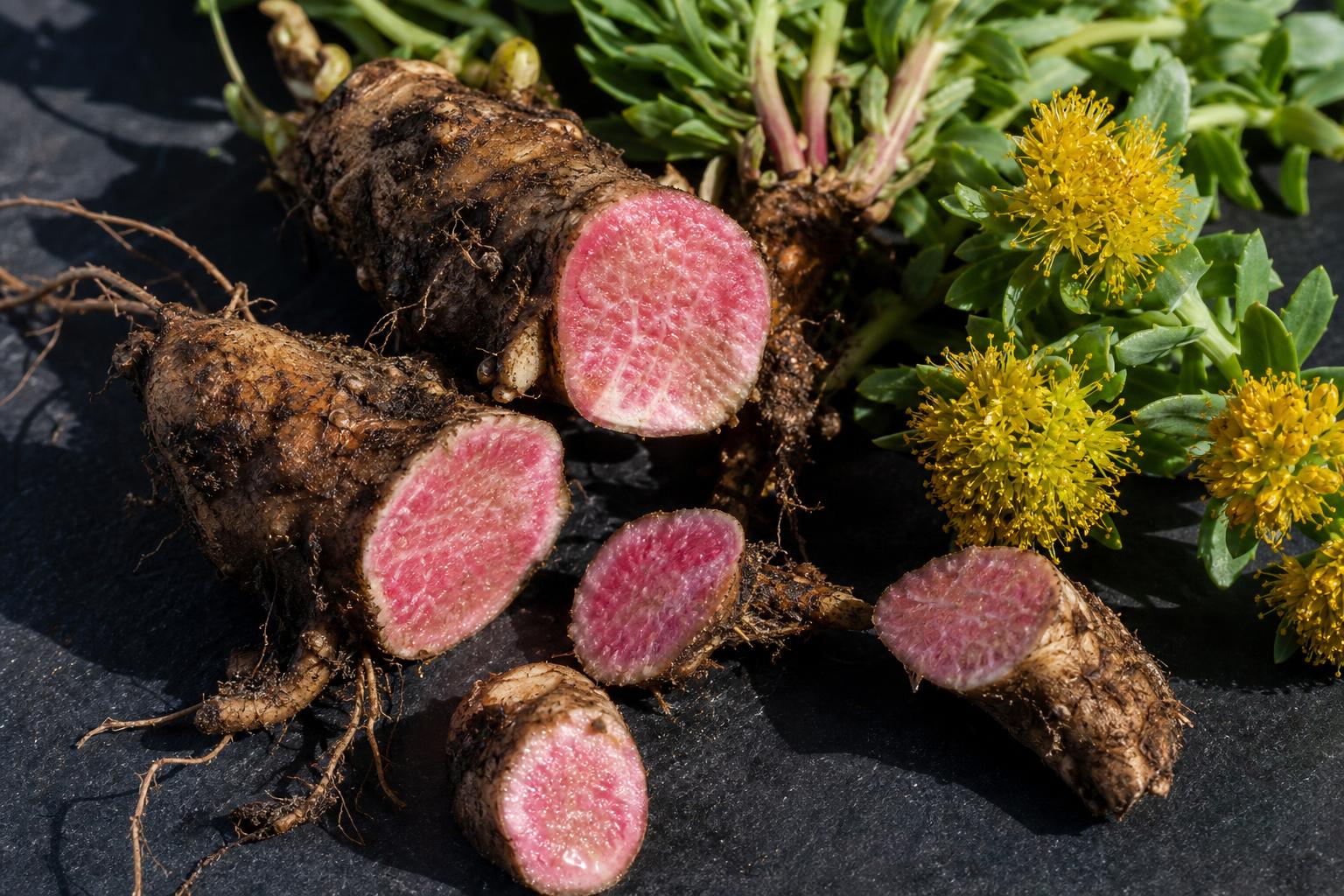
Rhodiola rosea is a perennial plant native to Siberia and Scandinavia, used in traditional medicine for over 1,300 years and studied extensively by Soviet researchers from the 1950s–1990s. It is classified as an adaptogen — a substance believed to help the body adapt to stress.
Rhodiola's effects are attributed to rosavins and salidroside acting on stress physiology rather than on alertness pathways. This is the key difference from stimulants and the reason its benefits are cumulative.
- HPA Axis Modulation
- Rhodiola appears to modulate the hypothalamic-pituitary-adrenal axis — the system governing cortisol release and stress response — acting like a thermostat for the stress system rather than a gas pedal.
- Rosavins & Salidroside
- The primary active markers are rosavins (1–3%) and salidroside (0.5–1%), alongside various flavonoids and organic acids. Standardization to these compounds is what distinguishes a verifiable product.
- Not Stimulation
- Unlike caffeine, which blocks adenosine receptors to mask fatigue, rhodiola appears to work on the underlying stress physiology — which is why effects are gradual rather than acute.
Forms of Rhodiola
Form matters significantly for rhodiola — more than for many herbs. The SHR-5 standardized extract (min 1% salidroside, 3% rosavins) is the form used in most clinical trials and the best default. Root powder is cheaper but has variable potency and minimal direct research. Tinctures absorb fastest (15–30 min) but often contain alcohol. Generic standardized capsules are convenient but vary widely by brand.
Dosage & Timing
| Form | Typical Range | Notes |
|---|---|---|
| Starting dose | 200 mg/day | Standardized extract, morning |
| Standard maintenance | 300–400 mg/day | Morning; most common effective range |
| High-stress periods | up to 600 mg/day | Morning / early afternoon |
| Studied upper range | up to 1,500 mg/day | No serious toxicity reported; no established upper limit |
Take in the morning or early afternoon. No loading phase is needed — benefits accumulate gradually. General ranges, not medical advice.
Safety & Who Should Avoid It
Swipe or scroll sideways for every safety note.
Rhodiola Product Picks
Best Value
NOW Foods
NOW Rhodiola 500 mg
Budget pick for a common Rhodiola rosea capsule from a mainstream brand.
View on Amazon →Best Overall
Gaia Herbs
Gaia Herbs Rhodiola Rosea
Best overall pick for users who want a recognizable botanical brand and liquid phyto-caps format.
View on Amazon →Premium Pick
Thorne
Thorne Rhodiola
Premium pick for users prioritizing brand quality signals and transparent standardized extract positioning.
View on Amazon →Affiliate disclosure: as an Amazon Associate we earn a small commission on qualifying purchases at no extra cost to you.
References
- [1] Panossian A, Wikman G. (2010). Effects of adaptogens on CNS. Pharmaceuticals, 3(1): 188-224. PubMed →
- [2] Olsson EM, et al. (2009). Rhodiola rosea for stress-related fatigue. Planta Med, 75(2): 105-112. PubMed →
- [3] Ishaque S, et al. (2012). Rhodiola for fatigue: systematic review. BMC Complement Altern Med, 12: 70. PubMed →
- [4] Darbinyan V, et al. (2000). Rhodiola rosea in stress-induced fatigue. Phytomedicine, 7(5): 365-371. PubMed →
- [5] Cropley M, et al. (2015). Rhodiola rosea on self-reported stress. Phytother Res, 29(12): 1934-1939. PubMed →
Affiliate-ready sourcing
Product recommendations
Use these as sourcing starting points, not medical recommendations. Product quality, dose, and fit still need review.
Affiliate disclosure: we may earn a commission from qualifying links at no extra cost to you. How we stay independent.
Common Questions About Rhodiola
Free safety checklist
Get the evidence-first supplement notes
Occasional research updates, practical safety context, and new guide announcements. No diagnosis, treatment, or personal medical advice.
We use your email to send the checklist and occasional evidence-first supplement updates. Unsubscribe anytime. Privacy policy.