Evidence Review · 12 References
Bovine Colostrum: What the Evidence Actually Shows
Bovine colostrum is heavily marketed for immunity, gut health, recovery, and performance. Human research does show signals in several of those areas, but the evidence is heterogeneous: products, doses, populations, and outcomes differ substantially. Here’s what the research actually supports — and what it doesn’t — with citations to the source literature.
Quick answer
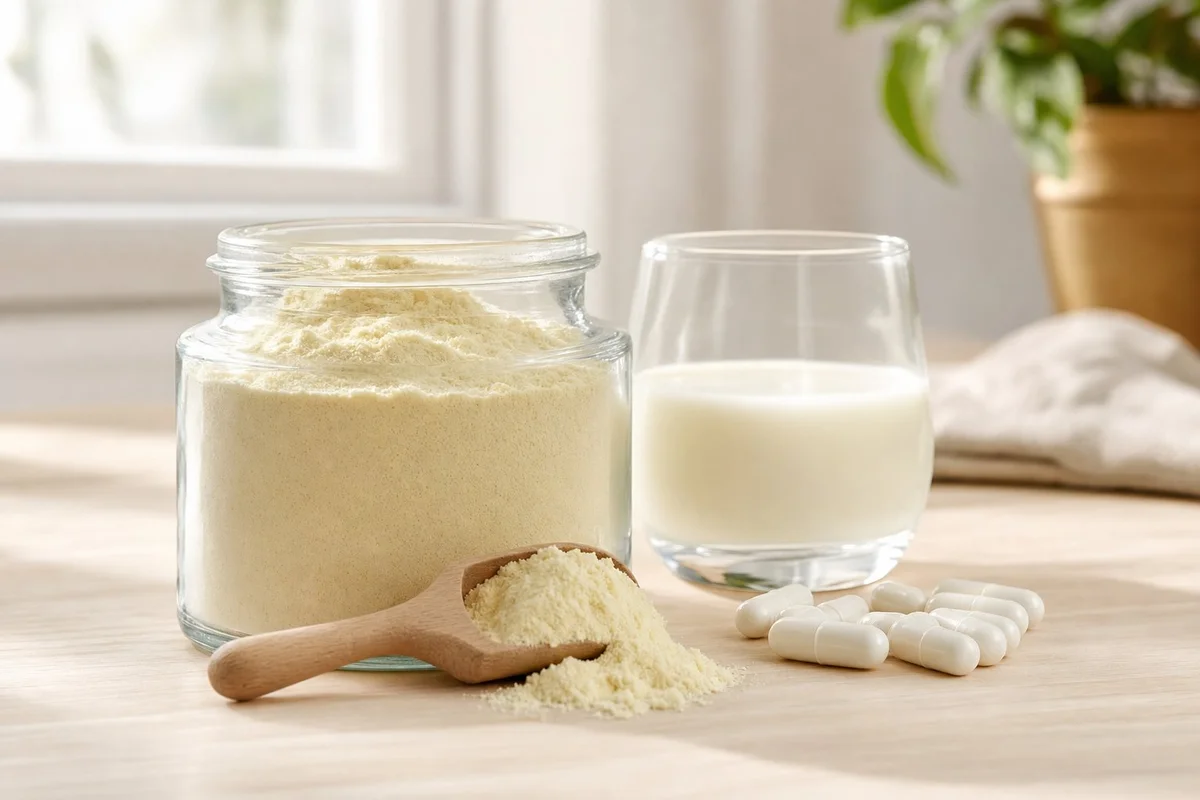
Permanent linkBovine colostrum contains higher concentrations of protein, immunoglobulins, growth factors, and other bioactive compounds than mature milk, but its composition varies considerably [3,7]. In humans, the clearest signals are exercise-associated gut-barrier outcomes [9] and upper-respiratory-symptom reduction during exercise training [12], while pooled effects on common immune biomarkers are small or absent [2]. There is no single validated dose: studies use widely different formulations and amounts, so benefits from one protocol cannot simply be assumed for another product or serving size.
At a Glance · Colostrum Evidence
| Claim | Evidence | Representative Dose | Key Caveat |
|---|---|---|---|
| Immune / URS | Mixed | 10-60 g/day in athlete trials [8,12] | Respiratory-symptom signal; pooled biomarkers mostly small/null [2] |
| Gut Barrier | Promising | Study-specific, including sub-gram to multi-gram protocols [9] | Methods and formulations vary substantially |
| Athletic Performance / Recovery | Mixed | 20-60 g/day in selected trials [5,6] | Benefits are outcome-specific, not a general performance effect |
| Anti-Aging | Insufficient | N/A | No established human anti-aging outcome |
The real dose problem is heterogeneity, not one universal gap.
Human studies use very different bovine-colostrum preparations and doses, from sub-gram protocols in some gut-barrier research to 10-60 g/day in sports studies and 100 g/day in a clinical diarrhea trial [4,6,8,9]. Results should be interpreted as formulation- and outcome-specific rather than as proof that every commercial serving is equivalent.
What is bovine colostrum?
Colostrum is the first milk produced after parturition. Compared with mature bovine milk, it is richer in protein and immunologically active compounds such as immunoglobulins, lactoferrin, cytokines, and growth factors [3,7]. Its composition is highly variable and changes rapidly after calving, which is one reason results from one raw material or commercial preparation should not automatically be generalized to another.
Commercial supplements are produced by collecting and processing bovine colostrum into powders, capsules, or other preparations. Collection timing, source material, and heat treatment can alter composition and physicochemical properties [7]. For consumers, documented composition, manufacturing controls, and independent contaminant/potency testing are more meaningful than marketing labels alone.
Evidence by claim
Immune support — Mixed evidence
The evidence depends on the outcome measured. A 2020 systematic review and meta-analysis of 10 randomized trials (239 participants) found no or fairly low pooled effects on serum IgA/IgG, lymphocytes, neutrophils, and salivary IgA in trained or physically active people [2]. Individual studies still show signals: Crooks et al. (2006) studied 35 distance runners and found median salivary IgA increased by 79% after 12 weeks, while cautioning that the sample was small and variability was large [1]. In 29 trained male cyclists, 10 g/day altered several post-exercise immune measures and produced a trend toward fewer upper-respiratory-illness symptoms (p = 0.055) [8]. A separate 2016 meta-analysis of five exercise-training trials found fewer upper-respiratory-symptom days and episodes, but four of the five studies had moderate or high overall risk of bias [12].
Gut health & permeability — Promising but heterogeneous
A 2022 systematic review identified nine human athlete studies assessing exercise-associated gut permeability and found an overall signal favoring bovine-colostrum supplementation, while emphasizing the need for better placebo-controlled trials and clearer dose schedules [9]. Individual protocols vary sharply: one placebo-controlled athlete study reported improved permeability measures after a 500 mg/day preparation, while other exercise studies have used much larger doses. In a separate clinical context, Kaducu et al. studied 87 people with HIV-associated diarrhea using 100 g/day of a bovine-colostrum-based supplement and reported improved diarrhea outcomes [4]. These results should not be collapsed into a single universal gut-health dose.
Athletic performance & recovery — Mixed evidence
Jones et al. (2015) randomized active men to 20 g/day bovine colostrum or placebo for four weeks and found a greater receptor-mediated neutrophil oxidative-burst response after prolonged cycling, but no effects on several other immune measures [5]. That study was about exercise-associated immune responses, not proof of a broad performance enhancement. In 40 older adults completing resistance training, Duff et al. found that 60 g/day bovine colostrum increased leg-press strength by 24 ± 29 kg versus 8 ± 16 kg with whey and produced a greater reduction in urinary N-telopeptides; bench press strength, muscle thickness, lean tissue mass, bone mineral content, and cognitive scores improved over time without a between-group difference [6]. Overall, performance/body-composition evidence remains limited and outcome-specific.
Anti-aging, cognition, fat loss — Insufficient evidence
Human evidence does not establish bovine colostrum as an anti-aging, cognitive-enhancement, or fat-loss intervention. IGF-1 content is often invoked as a mechanism, but a radiolabeled human study found no support for absorption of intact ingested IGF-I from bovine colostrum [10]. Separately, epidemiological evidence links circulating IGF-I biology with cancer risk in complex, outcome-dependent ways [11]; neither line of evidence supports marketing colostrum as an anti-aging hormone delivery system.
Dose and formulation: why studies do not transfer cleanly
There is no single clinically established bovine-colostrum dose across indications. Human trials have used widely different amounts and preparations, including sub-gram dosing in some athlete gut-permeability work, 10 g/day in trained cyclists [8], 20 g/day in exercise-immunity studies [5], 60 g/day during resistance training [6], and 100 g/day in an HIV-associated diarrhea trial [4]. Reviews also emphasize variability in colostrum composition and product bioactivity [3,7]. A commercial 1-2 g serving therefore should not be assumed ineffective simply because some trials used more, nor should a positive high-dose trial be used to guarantee benefit from a smaller unrelated product.
Supplement quality guide
| Factor | What to look for | Red flags |
|---|---|---|
| Composition | Quantified protein/immunoglobulin content and serving size | No meaningful composition disclosure |
| Processing | Documented collection and heat-processing approach [7] | No processing or sourcing information |
| Testing | Independent contaminant and potency testing | No COA or testing transparency |
| Dose claims | Claims tied to the exact studied formulation and outcome | Treating one trial dose as universal for all products |
Safety
Milk allergy: Bovine colostrum contains cow’s-milk proteins; people with a cow’s-milk protein allergy should avoid it.
IGF-1 claims: Colostrum contains IGF-I, but a human radiolabel study did not support absorption of intact ingested IGF-I [10]. That does not establish safety for every hormone-sensitive condition, so individualized medical guidance is appropriate when risk is clinically relevant.
Pregnancy/lactation: Direct safety evidence is insufficient for a routine recommendation.
GI effects: Short-term studies generally report acceptable tolerability, but GI symptoms can occur and formulations differ.
Long-term safety: Evidence is much thinner than short-term supplementation data.
Bottom line
Bovine colostrum has credible but uneven human evidence. The strongest recurring signals are reduced exercise-associated gut permeability in some studies [9] and fewer upper-respiratory symptoms during exercise training [12]. Pooled immune-biomarker effects are much less impressive [2], and general performance benefits remain inconsistent [5,6]. The key limitation is not a simple commercial-versus-research dose gap; it is that products, doses, populations, and endpoints vary enough that one positive trial cannot validate every colostrum supplement. Treat it as an outcome-specific intervention with uncertain product equivalence, not a universal immune or recovery powder.
References
- [1] Crooks CV, Wall CR, Cross ML, Rutherfurd-Markwick KJ. (2006). The effect of bovine colostrum supplementation on salivary IgA in distance runners. Int J Sport Nutr Exerc Metab, 16(1): 47-64. DOI →
- [2] Główka N, Durkalec-Michalski K, Woźniewicz M. (2020). Immunological Outcomes of Bovine Colostrum Supplementation in Trained and Physically Active People: A Systematic Review and Meta-Analysis. Nutrients, 12(4): 1023. PubMed →
- [3] Ramani A, Taherabbas S, Manik S. (2024). Bovine colostrum as a promising nutraceutical: a systematic review. Sustainable Food Technol, 2: 531-547. DOI →
- [4] Kaducu FO, et al. (2011). Effect of bovine colostrum-based food supplement in HIV-associated diarrhea in northern Uganda: a randomized controlled trial. Indian J Gastroenterol, 30(6): 270-276. PubMed →
- [5] Jones AW, Thatcher R, March DS, Davison G. (2015). Influence of 4 weeks of bovine colostrum supplementation on neutrophil and mucosal immune responses to prolonged cycling. Scand J Med Sci Sports, 25(6): 788-796. DOI →
- [6] Duff WRD, Chilibeck PD, Rooke JJR, et al. (2014). The effect of bovine colostrum supplementation in older adults during resistance training. Int J Sport Nutr Exerc Metab, 24(3): 276-285. PubMed →
- [7] McGrath BA, Fox PF, McSweeney PLH, Kelly AL. (2016). Composition and properties of bovine colostrum: a review. Dairy Sci Technol, 96(2): 133-158. DOI →
- [8] Shing CM, Peake J, Suzuki K, et al. (2007). Effects of bovine colostrum supplementation on immune variables in highly trained cyclists. J Appl Physiol, 102(3): 1113-1122. PubMed →
- [9] Dziewiecka H, Buttar HS, Kasperska A, et al. (2022). A Systematic Review of the Influence of Bovine Colostrum Supplementation on Leaky Gut Syndrome in Athletes: Diagnostic Biomarkers and Future Directions. Nutrients, 14(12): 2512. PubMed →
- [10] Mero A, et al. (2002). IGF-I, IgA, and IgG responses to bovine colostrum supplementation during training. J Appl Physiol, 93(2): 732-739. PubMed →
- [11] Renehan AG, et al. (2004). IGF-1, IGFBP-3 and cancer risk: systematic review and meta-regression. Lancet, 363(9418): 1346-1353. PubMed →
- [12] Jones AW, March DS, Curtis F, Bridle C. (2016). Bovine colostrum supplementation and upper respiratory symptoms during exercise training: a systematic review and meta-analysis of randomised controlled trials. BMC Sports Sci Med Rehabil, 8: 21. PubMed →
Frequently asked questions
Does bovine colostrum actually work for immunity?
Evidence is mixed and outcome-specific. A 2020 meta-analysis of 10 randomized trials found little or no pooled improvement in measured immune-cell and immunoglobulin outcomes [2], while individual studies found signals such as a 79% increase in salivary IgA in 35 distance runners [1] and altered immune responses in cyclists [8]. A separate meta-analysis found fewer upper-respiratory-symptom days and episodes during exercise training, but most included trials had moderate or high risk of bias [12].
Is colostrum good for gut health?
There is a promising signal for gut-barrier outcomes, especially around exercise, but studies use different products, doses, and permeability measures. A 2022 systematic review identified nine athlete studies and concluded that bovine colostrum may improve exercise-associated gut permeability, while calling for better randomized trials and clearer dose schedules [9]. In a very different clinical population, a trial in 87 people with HIV-associated diarrhea used 100 g/day and found improved diarrhea outcomes [4].
Can colostrum help with athletic performance?
Evidence for performance itself is limited and mixed. A 2015 randomized double-blind cycling study found changes in a neutrophil immune response after 20 g/day but did not establish a broad performance benefit [5]. In older adults doing resistance training, 60 g/day increased leg-press strength more than whey and reduced a bone-resorption marker, while several other outcomes improved similarly in both groups [6].
Is bovine colostrum safe?
Short-term studies generally report acceptable tolerability, but formulations and doses vary widely. Avoid bovine colostrum with a cow's-milk protein allergy. Long-term safety data are limited, and product composition can vary with collection and processing [3,7]. Pregnancy and lactation do not have enough direct safety evidence for a routine recommendation.
How much colostrum should I take?
There is no single evidence-based dose that applies to every goal or product. Human studies range from sub-gram doses in some gut-permeability work to 10-60 g/day in many athlete trials and 100 g/day in one HIV-associated diarrhea trial [4,6,8,9]. Because bovine-colostrum products differ in composition and bioactivity, a result from one dose and formulation should not automatically be transferred to another [3,7].
Free safety checklist
Get evidence reviews like this
We track supplement claims against clinical evidence so you don't have to. No hype, no affiliate bias.
We use your email to send the checklist and occasional evidence-first supplement updates. Unsubscribe anytime. Privacy policy.