Affiliate disclosure: we may earn a commission from qualifying links at no extra cost to you. How we stay independent.
Choose Magnesium if
- Muscle tension, restlessness, or difficulty physically winding down
- Low magnesium intake or deficiency risk may be part of the problem
- You want to test a relaxation-oriented option rather than alter sleep timing
Choose Melatonin if
- Jet lag, shift work, or a delayed sleep schedule
- You become sleepy later than the bedtime you need
- The main problem is circadian timing rather than physical tension
Use both if
- Do not start both at once. Test one ingredient first so you can identify benefit, side effects, and the lowest useful dose.
Neither is enough if
- Loud snoring, breathing pauses, persistent daytime sleepiness, restless legs, or chronic insomnia need clinical evaluation rather than another supplement.
- Best for circadian timing
- Melatonin
- Best for jet lag
- Melatonin
- Best when low magnesium is plausible
- Magnesium
- Best for universal insomnia relief
- Neither(match the cause first)
Supplement guide
Magnesium vs Melatonin
Complementary tools with distinct primary roles. Magnesium often supports relaxation, muscle ease, and sleep quality — particularly when intake is suboptimal or tension is present. Melatonin is more directly linked to sleep timing, onset latency, and circadian alignment (jet lag, schedule shifts). Effects are context-dependent.
Quick answer
- Falling asleep: melatonin, glycine, or theanine may fit best.
- Stress-related sleep issues: magnesium or theanine may be more relevant.
- Nighttime routines should avoid stacking too many sedating compounds at once.
Safety considerations
Renal impairment without clinician guidance; Concurrent sedative stacking without adjustment; Autoimmune caution or morning grogginess sensitivity; Sedative polypharmacy without supervision. Supplements are not risk-free, especially when combined with medications, medical conditions, pregnancy, surgery, sedatives, stimulants, or blood-pressure concerns.
Review full safety guidance →Common mistakes
- Using high-dose melatonin when a lower dose may fit better.
- Stacking several relaxing supplements on the first night.
- Ignoring caffeine timing, alcohol, sleep apnea, or medication interactions.
Who this guide is for
- People comparing natural sleep aids before buying.
- People who want timing, dose, and grogginess context.
- People trying to avoid random multi-ingredient sleep blends.
Who should be careful
- People using sedatives or sleep medications.
- Pregnant or breastfeeding individuals.
- Anyone with medical conditions affecting sleep, breathing, mood, or medication safety.
How to choose supplements for sleep support
Not all supplements targeting sleep support work the same way. Some are designed for short-term support, some require consistent use, and some only make sense for specific situations or populations. Match the compound, timing, and safety profile to the problem you are actually trying to solve.
- Check whether the expected effect is acute, gradual, or dependent on baseline deficiency.
- Compare stimulant, calming, fiber, adaptogen, or nutrient-style approaches before stacking products.
- Look at interaction risks, medical context, and safety notes before combining multiple compounds.
Comparison context
Melatonin is mainly a sleep-timing signal, while magnesium, glycine, and theanine are usually framed around relaxation, stress, or sleep quality support.
Compare ranked options →Related compounds
These links are generated from the current compound dataset and goal mapping, so this guide points into real dataset-linked profiles.
caffeine l-theanine
May support acute attention and mood outcomes in healthy participants.
Electrolytes - Magnesium Blend
Magnesium blends support deficiency correction and neuromuscular function, but cramp evidence is mixed.
Extended-release melatonin
Circadian rhythm support; safety screen: pregnancy without clinician guidance; sedatives; next-day drowsiness risk.
Glycinate Magnesium Complex
Glycinate Magnesium Complex is best framed as a conservative research profile with mechanistic evidence and a focus on Sleep; Cognition; Stress Response; Neurobiology. Current workbook signals support mechanistic context around Neurotransmitter Modulation; Stress Response Modulation, not treatment claims.
L-theanine
Calm focus; caffeine smoothing; safety screen: low blood pressure; sedative stacking caution.
L-Theanine (Sleep Use)
May support sleep quality, sleep-onset related outcomes, and next-day refreshment in some adult contexts.
Lemon balm
Lemon balm may support gentle calm, stress-related sleep, and relaxed focus with preparation-dependent effects.
Lemon Balm Extract
Lemon Balm Extract is best framed as a conservative research profile with mechanistic evidence and a focus on Sleep; Cognition; Stress Response; Neurobiology. Current workbook signals support mechanistic context around Neurotransmitter Modulation; Stress Response Modulation, not treatment claims.
Sourcing & Comparison Matrix
Commercial Decision Table
Compare candidate compounds by role, evidence strength, caution markers, and standardized active form before you click through to check top-rated products.
| Compound Name | Primary Fit | Evidence Tier | Caution Level | Quality Form | Action |
|---|---|---|---|---|---|
| caffeine l-theanine | May support acute attention and mood outcomes in healthy participants. | Moderate evidence | Safety evidence: the combination's risk is strongly influenced by caffeine dose and individual sensitivity. Sleep disruption, anxiety-like symptoms, cardiovascular effects, pregnancy intake limits, total caffeine exposure, and concurrent stimulants require attention; long-term combination-specific evidence remains limited. | Standard extract | Shop Picks → |
| Electrolytes - Magnesium Blend | Magnesium blends support deficiency correction and neuromuscular function, but cramp evidence is mixed. | Editorial grade not demonstrated by recorded studies | Safety evidence: magnesium can cause dose-related gastrointestinal effects and severe renal impairment increases hypermagnesemia risk. It can reduce absorption of some oral antibiotics and bisphosphonates; all other risks depend on the blend's exact electrolytes and doses. | Standard extract | Shop Picks → |
| Extended-release melatonin | Circadian rhythm support; safety screen: pregnancy without clinician guidance; sedatives; next-day drowsiness risk. | Preliminary evidence | Safety evidence: extended release may prolong exposure and next-day drowsiness, but formulation-specific comparative safety evidence is limited. Headache and dizziness occur in melatonin trials; driving, concurrent sedatives, pregnancy, breastfeeding, pediatric use, and chronic use require individualized review. | Standard extract | Shop Picks → |
| Glycinate Magnesium Complex | Glycinate Magnesium Complex is best framed as a conservative research profile with mechanistic evidence and a focus on Sleep; Cognition; Stress Response; Neurobiology. | Preliminary evidence | Safety evidence: magnesium supplements can cause dose-related gastrointestinal effects. Severe renal impairment increases hypermagnesemia risk, and magnesium can reduce absorption of some oral antibiotics and bisphosphonates; pregnancy, breastfeeding, and long-term product-specific evidence remain limited. | Standard extract | Shop Picks → |
| L-theanine | Calm focus; caffeine smoothing; safety screen: low blood pressure; sedative stacking caution. | Moderate evidence | Safety evidence: a systematic review of short-term trials reported no serious adverse events, but study populations and dosing varied. Long-term use, pregnancy, breastfeeding, surgery, organ impairment, and clinically significant medication interactions remain insufficiently characterized. | Standard extract | Shop Picks → |
| L-Theanine (Sleep Use) | May support sleep quality, sleep-onset related outcomes, and next-day refreshment in some adult contexts. | Editorial grade not demonstrated by recorded studies | Safety evidence: this page does not define a formulation distinct from L-theanine. Short-term trials reported no serious adverse events, but long-term, pregnancy, breastfeeding, pediatric, surgery, organ-impairment, and clinically significant medication-interaction safety remain insufficient; this is not an insomnia treatment claim. | Standard extract | Shop Picks → |
| Lemon balm | Lemon balm may support gentle calm, stress-related sleep, and relaxed focus with preparation-dependent effects. | Preliminary evidence | Use caution with sedatives and thyroid-medication monitoring. | Standard extract | Shop Picks → |
| Lemon Balm Extract | Lemon Balm Extract is best framed as a conservative research profile with mechanistic evidence and a focus on Sleep; Cognition; Stress Response; Neurobiology. | Preliminary evidence | Drowsiness and GI upset possible; caution with sedatives and thyroid disease. | Standard extract | Shop Picks → |
Affiliate disclosure: we may earn a commission from qualifying links at no extra cost to you. How we stay independent.
Buying checkpoint
Before buying Magnesium vs Melatonin
Review evidence, dose, timing, and safety first. Product links should come after the profile fits your goal and risk context for magnesium vs melatonin for sleep, magnesium or melatonin, sleep timing vs relaxation support.
Affiliate disclosure: we may earn a commission at no extra cost. This never changes evidence or safety language.
Frequently asked questions
Can I take magnesium and melatonin together?
Yes, many people do so safely as they work through different pathways. Start with lower doses of each, pay attention to timing (magnesium earlier in the evening, melatonin closer to bed), and watch for excessive drowsiness. Individual tolerance varies.
How long does it take to notice benefits?
Melatonin often shows effects on onset within the first few uses (timing-dependent). Magnesium benefits for sleep quality or relaxation frequently build over 1–4+ weeks of consistent use, especially if addressing lower status. Track subjective and objective measures if possible.
Is one better than the other overall?
No simple winner — it depends on your primary need. Melatonin has more consistent data for circadian timing and onset latency issues. Magnesium shows promise for quality, relaxation, and deficiency-related sleep disruption. Many benefit from addressing both angles or the underlying contributors.
What about side effects or long-term use?
Both are generally well-tolerated short-to-medium term at appropriate doses. Magnesium: watch GI tolerance and kidney status. Melatonin: possible next-day grogginess or vivid dreams in sensitive users; timing is key. Long-term nightly use should be discussed with a clinician, alongside good sleep practices.
Which form of magnesium is best for sleep?
Glycinate or bisglycinate are frequently preferred for absorption and calming effects with fewer GI issues. L-threonate has emerging data for sleep architecture and daytime function. Oxide is less ideal for sleep-focused use due to lower bioavailability.
Does magnesium help produce melatonin?
There is some biological interplay (magnesium supports enzymatic steps in melatonin synthesis; deficiency can affect rhythms), but they are not direct substitutes. Supplementation of one does not reliably replace the need for the other in all contexts.
Related supplement guides
Best Supplements for Sleep
Compare sleep supplements by evidence, timing, next-day grogginess risk, and safety context before buying anything.
Read guide →Herbs for Sleep
A practical guide to sleep herbs and nighttime support options, organized by timing, safety, and real-world fit.
Read guide →Magnesium For Sleep
A practical guide to magnesium for sleep with evidence-strength context, related compounds, and a clear path into ranked decision pages.
Read guide →Magnesium vs melatonin at a glance
| Question | Magnesium | Melatonin |
|---|---|---|
| What does it primarily target? | Magnesium status, neuromuscular function, and relaxation | Circadian signaling and sleep timing |
| Best fit | Possible low intake, physical tension, or restlessness | Jet lag, delayed sleep phase, shift work, or schedule changes |
| Evidence boundary | Not consistently proven as a broad insomnia treatment in healthy adults | More convincing for timing and modest sleep-onset effects than for all-night sleep quality |
| Main practical risk | GI effects, medication absorption issues, and kidney-disease concerns | Poor timing, next-day drowsiness, vivid dreams, and medication interactions |
How they differ
Magnesium
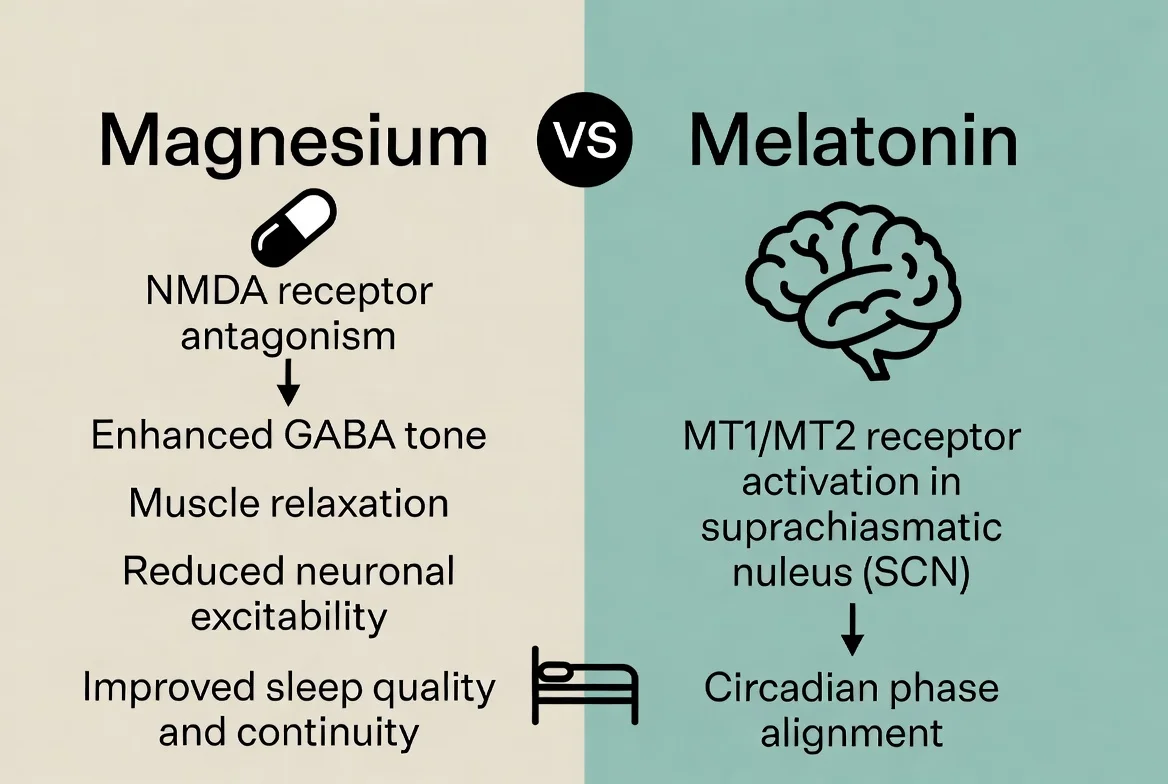
Magnesium participates in nervous-system and muscle function. That makes it biologically relevant to relaxation, but mechanism alone does not prove that supplementation improves insomnia. The strongest rationale is when low intake, deficiency risk, older age, or physical tension is part of the picture.
Melatonin
Melatonin is a circadian signal produced by the body at night. Supplemental melatonin can shift or reinforce sleep timing, which is why it fits jet lag and delayed schedules better than vague complaints of poor sleep quality.
Choose by sleep problem
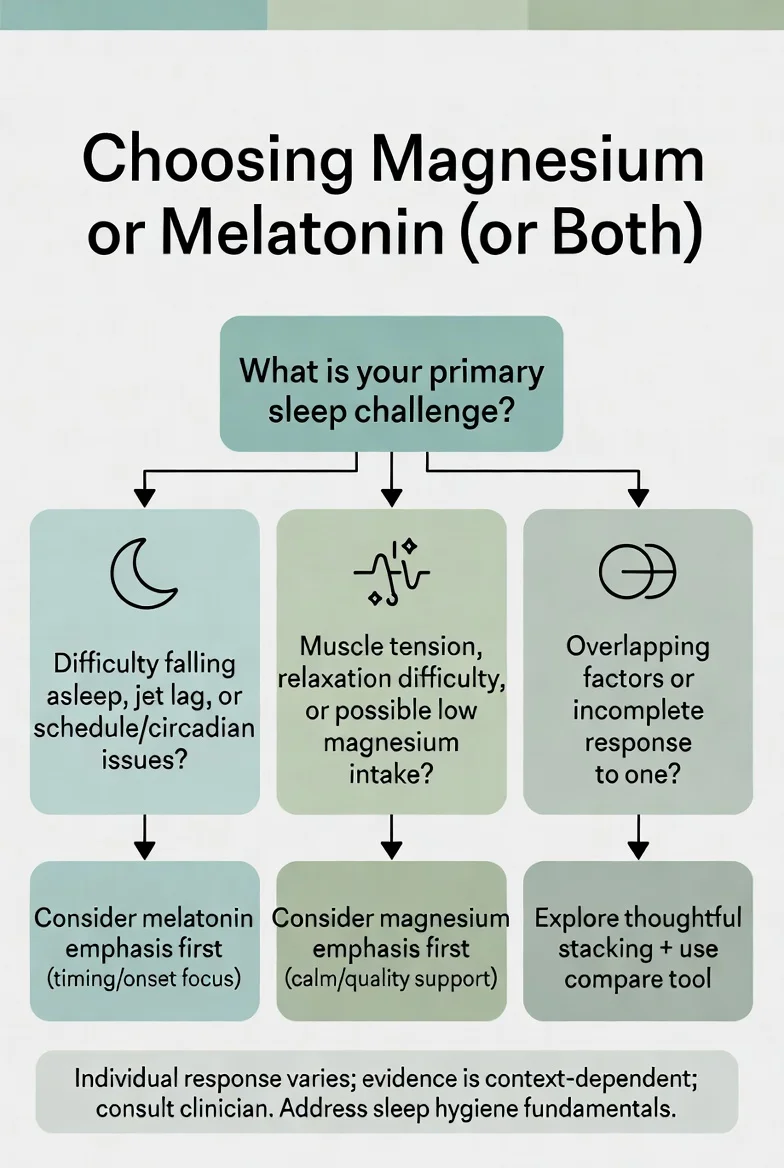
Choose magnesium first: when physical tension, low dietary intake, or deficiency risk is plausible. Treat it as a targeted trial, not a guaranteed sedative.
Choose melatonin first: when your clock is shifted and you are trying to sleep earlier than your body naturally becomes sleepy.
Choose neither first: when the problem is breathing disruption, pain, restless legs, medication effects, heavy caffeine use, alcohol-related sleep fragmentation, or persistent insomnia.
Buyer checklist
What to look for when buying magnesium
- Check the elemental magnesium amount, not only the weight of the full compound.
- Choose a clearly labeled form. Glycinate or bisglycinate is often selected for tolerability; oxide is more likely to cause gastrointestinal effects.
- Avoid proprietary blends that hide the amount of each ingredient.
- Prefer a single-ingredient product before trying a multi-supplement sleep blend.
- Review kidney disease and medication cautions before using supplemental magnesium.
Sourcing options
Product sourcing examples
Recommendation status
Product recommendations are not shown for this profile because the current site safety and monetization policy does not permit them.
Safety and when neither fits
Magnesium: supplemental forms can cause diarrhea or cramping, may affect absorption of some medicines, and require extra caution with impaired kidney function.
Melatonin: can cause next-day drowsiness and may interact with anticoagulants, sedatives, anticonvulsants, immunosuppressants, and other medicines.
Do not use stacking as the default: starting two products together makes it harder to tell which one helped or caused side effects.
Frequently asked questions
Should I take magnesium or melatonin for sleep?
They solve different problems. Melatonin is mainly a timing signal, so it fits a shifted clock — jet lag, shift work, or becoming sleepy later than the bedtime you need. Magnesium is a conditional relaxation option that is more plausible when dietary intake is low, deficiency risk exists, or physical tension overlaps with poor sleep. Match the supplement to the bottleneck rather than picking the more popular product.
Does magnesium actually help you sleep?
Treat it as a targeted trial rather than a guaranteed sedative. A sleep benefit is most plausible when low dietary intake, deficiency risk, or physical tension is part of the picture. It is not established as a general-purpose fix for every kind of insomnia, and choosing it when the real bottleneck is circadian timing is unlikely to help.
Can I take magnesium and melatonin together?
Do not start both at once. Testing one ingredient first is what lets you identify whether it helped, whether it caused side effects, and the lowest useful dose. Starting two products together makes it impossible to attribute either the benefit or the problem.
Which form of magnesium is best for sleep?
Check the elemental magnesium amount rather than the weight of the full compound. Glycinate or bisglycinate is often selected for tolerability, while oxide is more likely to cause gastrointestinal effects. Prefer a clearly labeled single-ingredient product over a proprietary sleep blend that hides how much of each ingredient it contains.
When is neither magnesium nor melatonin the right answer?
When the underlying cause is something a supplement does not address: breathing disruption, pain, restless legs, medication effects, heavy caffeine use, or alcohol-related sleep fragmentation. Loud snoring, breathing pauses, persistent daytime sleepiness, or chronic insomnia warrant clinical evaluation rather than another product.
What are the side effects of magnesium and melatonin?
Supplemental magnesium can cause diarrhea or cramping, may affect absorption of some medicines, and requires extra caution with impaired kidney function. Melatonin can cause next-day drowsiness and may interact with anticoagulants, sedatives, anticonvulsants, immunosuppressants, and other medicines. Review both against your current medications before starting either.
Source ledger
References
2 sources
Continue your sleep research
Keep exploring the evidence, or follow sleep research updates by email.
Bottom line
Pick melatonin for a timing problem. Consider magnesium when low intake or physical tension plausibly contributes. Start with one intervention, use the lowest practical dose, and reassess the underlying cause when sleep problems persist.
Free safety checklist
Get the evidence-first supplement notes
Occasional research updates, practical safety context, and new guide announcements. No diagnosis, treatment, or personal medical advice.
We use your email to send the checklist and occasional evidence-first supplement updates. Unsubscribe anytime. Privacy policy.