Evidence Review · 8 References · Updated August 16, 2026
Anti-Inflammatory Supplements: What the Evidence Actually Supports
“Anti-inflammatory” is too broad to rank supplements responsibly. A product can alter an inflammatory pathway or biomarker without improving pain, function, cardiovascular outcomes, or a specific inflammatory disease. This review therefore separates the evidence by outcome, population, formulation, and study type rather than declaring one universal best supplement.
Quick answer
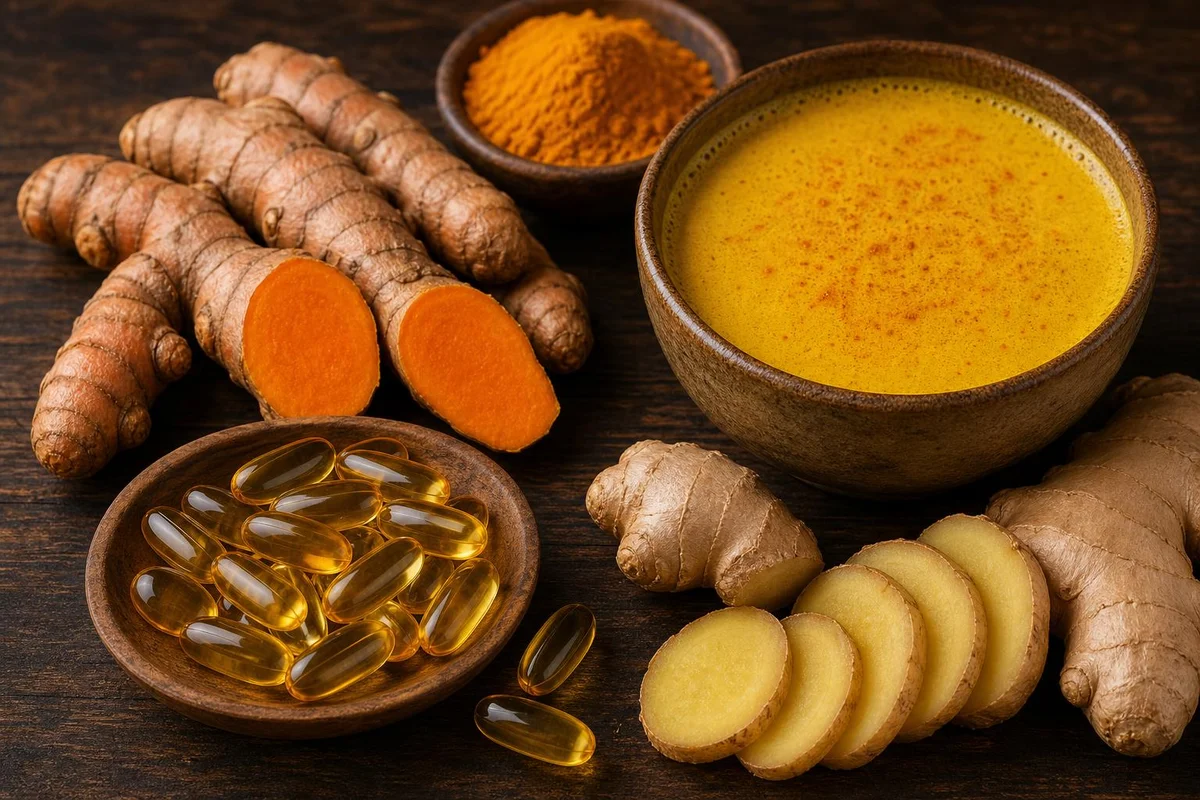
Permanent linkThe most defensible human evidence in this group is outcome-specific. Curcumin/turmeric and Boswellia have signals for knee-osteoarthritis symptoms, but results vary by formulation and synthesis [1,4,8]. Omega-3 EPA/DHA has established anti-inflammatory biology and selected clinical evidence, but effects differ by condition and high-dose prescription uses should not be collapsed into a generic supplement recommendation [2,7]. Ginger has a human pain signal for primary dysmenorrhea, with substantial heterogeneity and incomplete safety reporting [3]. Quercetin has interesting inflammatory biology, but the cited literature is much more mechanistic than proof of a specific clinical anti-inflammatory treatment [5].
None of these evidence bases supports a universal “anti-inflammatory stack,” a single consumer dose for “inflammation,” or replacing diagnosis and established treatment of an inflammatory condition with supplements.
Outcome-specific evidence ledger
Five ingredients, five different evidence questions
| Ingredient | Best-supported question here | What the evidence says | Main limitation |
|---|---|---|---|
| Curcumin / turmeric | Knee-OA pain and function | Several syntheses report symptom signals, including formulation-specific effects [1,8] | Products and bioavailability strategies differ; NCCIH says evidence is not definitive and reports liver injury with some highly bioavailable formulations [6] |
| Omega-3 EPA/DHA | Inflammatory pathways and selected disease-specific outcomes | Human evidence includes rheumatoid-arthritis and cardiometabolic contexts, but results are condition-specific [2,7] | Retail supplements, diet, and prescription high-dose omega-3 are not interchangeable evidence categories; 4-g/day trials have shown a small atrial-fibrillation signal in high-risk populations [7] |
| Ginger | Primary dysmenorrhea pain | A 2024 meta-analysis found lower pain intensity and duration versus placebo [3] | High heterogeneity; safety reporting was incomplete; this does not establish ginger as a universal anti-inflammatory or muscle-recovery treatment [3] |
| Boswellia | Knee-OA symptoms | Some formulations and analyses report symptom improvement [1] | A separate 2024 meta-analysis found no significant pooled WOMAC/VAS effect because of high heterogeneity, so a category-wide grade would hide real disagreement [4] |
| Quercetin | Inflammatory mechanisms and immune biology | Mechanistic and preclinical literature is substantial [5] | That is not the same as robust evidence for treating allergy, mast-cell disease, arthritis, or a generic state of “inflammation” in humans |
Why the old stack model fails
Mechanisms do not make ingredients automatically additive
Two supplements can act on different inflammatory pathways without a trial showing that the combination improves a patient-important outcome. The previous version of this guide converted pathway diversity into a default curcumin-plus-omega-3 stack and then suggested adding ginger or Boswellia. The cited evidence does not establish that sequence as a validated treatment strategy.
A better approach is to start with the actual clinical problem: for example, knee-OA symptoms, severe hypertriglyceridemia, primary dysmenorrhea, rheumatoid arthritis, or an unexplained elevated inflammatory marker. Those are different questions and can require very different evaluation and treatment.
Safety and formulation boundaries
“Natural” does not remove dose, interaction, or product-quality questions
- Curcumin: NCCIH notes substantial formulation variability and reports liver injury in some users of highly bioavailable formulations [6]. That makes “more absorption is always better” an unsafe shortcut.
- Omega-3: NIH ODS separates food intake, supplements, and prescription products and notes medication interactions plus a small atrial-fibrillation signal in some long-term 4-g/day trials [7].
- Ginger: a condition-specific efficacy signal does not substitute for a complete safety database; the 2024 dysmenorrhea synthesis noted infrequent safety reporting [3].
- Boswellia: extract composition matters. Results from one standardized formulation should not be generalized automatically to every retail resin extract [1,4].
- Quercetin: strong mechanism language is not a clinical indication. Medication use, pregnancy, kidney/liver disease, or other medical conditions can change whether supplement use deserves professional review.
Evidence applicability
What this page does not claim
- It does not claim that lowering CRP or changing an inflammatory pathway automatically improves symptoms or prevents disease.
- It does not rank a supplement as “best” across osteoarthritis, autoimmune disease, cardiovascular disease, exercise soreness, and menstrual pain.
- It does not convert study doses into a personalized protocol.
- It does not assume that curcumin, omega-3, ginger, Boswellia, and quercetin are safer than NSAIDs or prescription treatment as a class.
- It does not treat one branded or bioavailability-enhanced formulation as evidence for all products with the same ingredient name.
Bottom line
Several supplements marketed as anti-inflammatory have legitimate human research, but the evidence is condition-specific and formulation-sensitive. Curcumin and Boswellia have the clearest discussion here in knee osteoarthritis, ginger has a signal in dysmenorrhea, omega-3 evidence varies by disease and product type, and quercetin remains much stronger mechanistically than clinically. The useful edge is not a five-product stack—it is matching a claim to the outcome that was actually studied and preserving the uncertainty around safety, formulation, and generalizability [1-8].
Frequently asked questions
What is the best natural anti-inflammatory supplement?
There is no evidence-based universal winner. Curcumin and Boswellia have human evidence for some knee-osteoarthritis symptoms, omega-3 fatty acids have anti-inflammatory biology plus selected rheumatoid-arthritis and cardiovascular evidence, and ginger has human evidence for primary dysmenorrhea. Those are different outcomes, populations, products, and evidence bases—not one ranking.
Can turmeric or curcumin replace ibuprofen or another NSAID?
Do not treat turmeric or curcumin as a drop-in replacement for an NSAID. Some osteoarthritis trials and syntheses report symptom improvement, but formulation and study quality vary and NCCIH says the evidence is not definitive. Do not stop or replace prescribed or over-the-counter medicines without discussing the reason, risks, and alternatives with a clinician or pharmacist.
How much omega-3 should someone take for inflammation?
There is no universal EPA+DHA dose validated for a generic diagnosis of “inflammation.” Dose and formulation depend on the studied outcome. High-dose prescription omega-3 therapy for severe hypertriglyceridemia is a different clinical use from taking a retail fish-oil supplement, and high-dose trials have identified risks that matter in selected patients.
What causes chronic inflammation?
Inflammation is a biological process, not one diagnosis. Persistent inflammatory activity can accompany infections, autoimmune disease, obesity, smoking, sleep disruption, periodontal disease, inflammatory disorders, and many other conditions. A supplement should not substitute for identifying and treating the underlying cause when symptoms or abnormal inflammatory markers are persistent.
Should curcumin, omega-3, ginger, and Boswellia be stacked together?
There is not a robust clinical evidence base showing that a four-supplement stack produces better patient-important outcomes than using an appropriately chosen intervention for a specific indication. Combining supplements can also change tolerability and interaction risk. Use the evidence for the actual condition and review combinations with a clinician or pharmacist when medications, pregnancy, bleeding risk, liver disease, or other medical issues are relevant.
Related reading
Go deeper on the ingredients and outcome-specific evidence:
Sourcing options
Curcumin product examples
Recommendation status
Product recommendations are not shown for this profile because the current site safety and monetization policy does not permit them.
Source ledger
References
8 sources
- 01Inprasit C, et al. Evaluating the efficacy and safety of Curcuma longa, Boswellia serrata, and their mixed formulation in treating knee osteoarthritis: a systematic review and network meta-analysis. Complement Ther Med. 2026;96:103256. PMID 41082950. PubMed →
- 02Calder PC. Omega-3 fatty acids and inflammatory processes: from molecules to man. Biochem Soc Trans. 2017;45(5):1105-1115. PMID 28900017. PubMed →
- 03Moshfeghinia R, et al. Ginger for Pain Management in Primary Dysmenorrhea: A Systematic Review and Meta-Analysis. J Integr Complement Med. 2024;30(11):1016-1030. PMID 38770631. PubMed →
- 04Dalmonte T, et al. Efficacy of Extracts of Oleogum Resin of Boswellia in the Treatment of Knee Osteoarthritis: A Systematic Review and Meta-Analysis. Phytother Res. 2024;38(12):5672-5689. PMID 39314013. PubMed →
- 05Li Y, et al. Quercetin, Inflammation and Immunity. Nutrients. 2016;8(3):167. PMID 26999194. PubMed →
- 06National Center for Complementary and Integrative Health. Turmeric: Usefulness and Safety. Current evidence and safety summary, including formulation variability and reported liver injury with some highly bioavailable products. Source →
- 07NIH Office of Dietary Supplements. Omega-3 Fatty Acids: Health Professional Fact Sheet. Current efficacy, safety, and interaction summary. Source →
- 08Daily JW, et al. Efficacy of Turmeric Extracts and Curcumin for Alleviating the Symptoms of Joint Arthritis: A Systematic Review and Meta-Analysis of Randomized Clinical Trials. J Med Food. 2016;19(8):717-729. PMID 27533649. PubMed →
Free safety checklist
Get evidence reviews like this
Anti-inflammatory, omega-3, curcumin — evidence, not hype.
We use your email to send the checklist and occasional evidence-first supplement updates. Unsubscribe anytime. Privacy policy.