Herb Profile
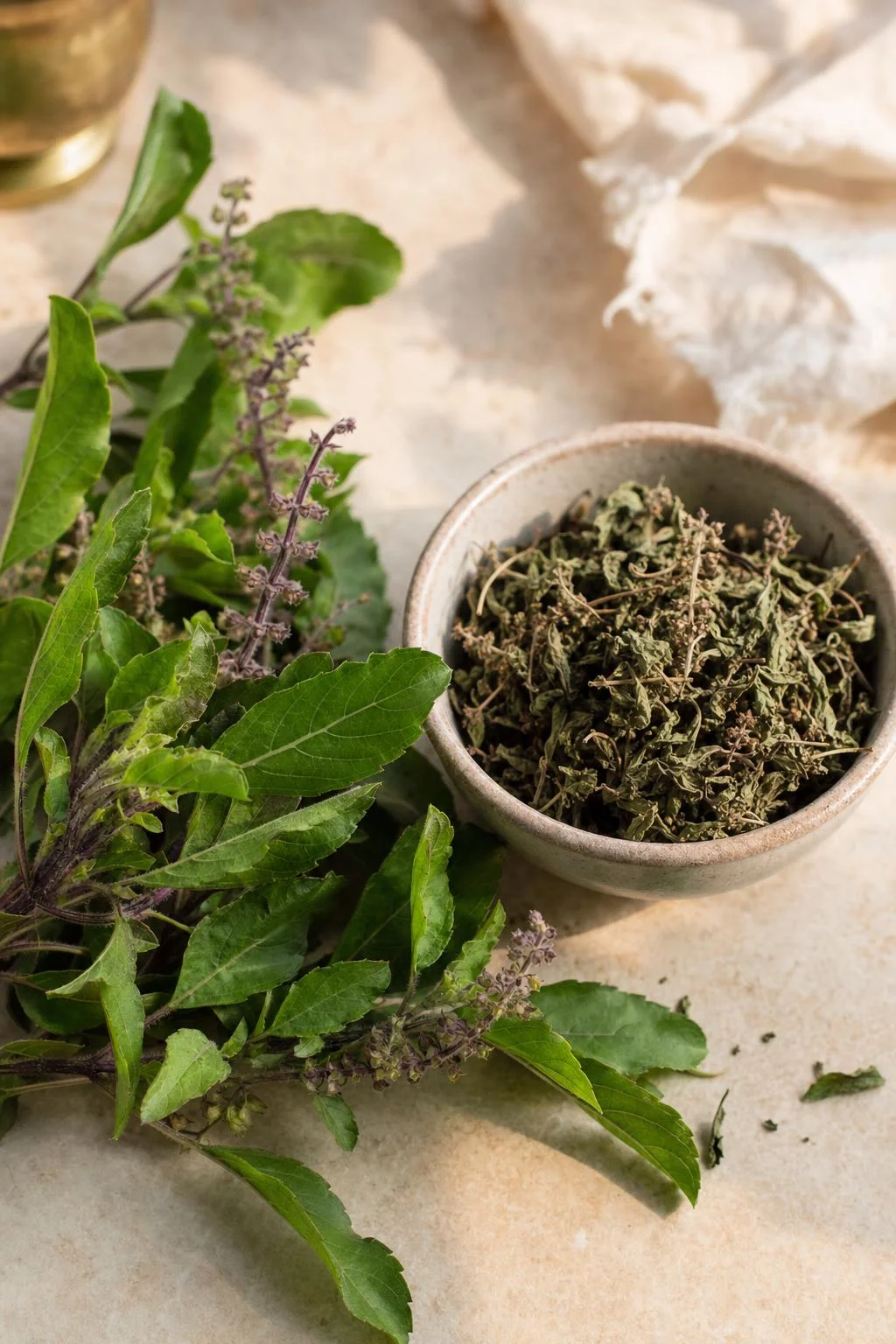
Holy Basil / Tulsi Ocimum Tenuiflorum
Holy basil is best framed for stress adaptation over time, not acute anxiety relief.
Last reviewed: •1 human studies cited
B ModerateUse extra caution — Generally well tolerated; may lower blood sugar or blood pressure; caution with glucose lowering, antihypertensive, and anticoagulant medications; avoid pregnancy/breastfeeding unless clinician supervised. Details
- Evidence
- Strong Human Evidence
- Typical onset
- Varies by prep
- Safety rating
- High caution
- Best for
- Stress Response, Oxidative Stress, Metabolic Health, Neurobiology
- Avoid / review if
- Diabetes (Monitor Glucose), Antidiabetic Drugs, Anticoagulants (Theoretical)
Monograph visual
Holy Basil / Tulsi Ocimum Tenuiflorum
The Hippie Scientist
Where to go next — guides & comparisons
Continue reading
- If you want help with anxiety or stress → Anxiety & stress guides
- If you want to browse more herbs → All herbs
Safety & Cautions
Generally well tolerated; may lower blood sugar or blood pressure; caution with glucose lowering, antihypertensive, and anticoagulant medications; avoid pregnancy/breastfeeding unless clinician supervised.
28%
High caution — review carefully
Detailed safety fields
Pregnancy, breastfeeding, and contraindications
- - Diabetes (Monitor Glucose)
- - Antidiabetic Drugs
- - Anticoagulants (Theoretical)
Safety classifications
- - Pregnancy/Breastfeeding Caution: Pregnancy or breastfeeding caution language is present.
Full safety note
- - Generally well tolerated; may lower blood sugar or blood pressure; caution with glucose lowering, antihypertensive, and anticoagulant medications; avoid pregnancy/breastfeeding unless clinician supervised.
Safety labels
- - Pregnancy/Breastfeeding Caution
Evidence-based safety
Caution when combined
These pairings share a flagged risk mechanism. They are additive-effect cautions derived from contraindication data, not confirmed clinical interactions. Consult a clinician before combining.
High-Priority Caution
147 flagged pairingsBleeding / anticoagulant risk
High-Priority Caution
147 flagged pairingsBleeding / anticoagulant risk
Browse the grouped cautions below. The list scrolls inside this card when long.
- aescin
- Aged Garlic Extract
- ajoene
- Ajwain
- Allicin
- Garlic
- American Ginseng Extract
- Andrographis
- Angelica Archangelica
- Angelica Dahurica
- Angelica Pubescens
- Angelica Root
- Angelica Sinensis
- Arjuna
- Artemisia Capillaris
- Artichoke
- Ashitaba
- Ashitaba Extract
- Astaxanthin
- Berberis
- Black Seed
- Black Seed Oil
- Blueberry
- Boldo
- Boswellia
- Capsicum
- Caraway
- Carnitine L Tartrate
- Cayenne
- Chamomile
- Chinese Skullcap
- Chuanxiong
- Cissus
- Citicoline
- Clove
- Cnidium Monnieri
- Coleus Forskohlii
- Commiphora Mukul
- Coenzyme Q10
- Cordyceps
- Cranberry (Vaccinium macrocarpon)
- crocetin
- crocin
- cryptotanshinone
- Curcuma Wenyujin
- Curcumin
- Damiana
- Danshen
- Devils Claw Extract
- Dong Quai
- EGCG
- Epimedium
- Epimedium Brevicornum
- Evening Primrose (Oenothera biennis)
- Fenugreek
- Fenugreek Extract
- ferulic acid
- Feverfew
- Fisetin
- forskolin
- Fraxinus Rhynchophylla
- Fucoxanthin
- Galangal
- Reishi
- Garcinia Mangostana
- Garlic (Allium sativum)
- Garlic Aged Extract
- Garlic Extract
- Ginger (Zingiber officinale)
- Ginkgo
- Ginkgo Biloba Extract
- Ginkgo Extract EGb 761
- Panax Red Ginseng
- Panax White Ginseng
- ginsenoside rg3
- Glucosamine
- Goldenseal
- Lion's Mane
- Horse Chestnut
- hydroxytyrosol
- Japanese Knotweed
- Kudzu
- L-Carnitine
- Ligusticum Chuanxiong
- Magnolia
- Mangosteen
- Maral Root
- Chamomile
- Melatonin
- MSM
- Myrtle
- Nettle Root
- Nigella Sativa
- Noni
- Notoginseng
- Ocimum Basilicum
- Olive Leaf Extract
- Oregano
- Paeonia Lactiflora
- Asian Ginseng
- Panax Ginseng Extract
- Papaya Leaf
- Pastinaca Sativa
- Pau D'arco
- Perilla
- Phosphatidylserine
- Piper Longum
- Bifidobacterium Probiotic
- Lactobacillus Probiotic
- Probiotics - Bifidobacterium spp.
- Probiotics - Lactobacillus spp.
- Psoralea Corylifolia
- Pycnogenol
- Quercetin
- Quercetin Phytosome
- Red Clover
- Reishi (Ganoderma lucidum)
- Resveratrol
- Rhodiola Extract SHR-5
- Rose Hips
- Rosemary
- Saffron
- Saffron Extract
- Salvia miltiorrhiza
- Saw Palmetto (Serenoa repens)
- Saw Palmetto Extract
- Schisandra Berry
- Schisandra Chinensis
- Scutellaria Baicalensis
- Selaginella Tamariscina
- Soybean
- Syzygium Aromaticum
- Terminalia arjuna
- Thunder God Vine
- Thyme
- Tongkat Ali
- Trans-Resveratrol
- Fenugreek
- Tripterygium Wilfordii
- Turmeric (Curcuma longa)
- Turmeric Curcumin + Piperine
- Valerian
- Vitamin D3 + K2
- Grape
- White Peony
- Willow Bark Extract
- Yarrow
Moderate Caution
110 flagged pairingsBlood-sugar lowering
Moderate Caution
110 flagged pairingsBlood-sugar lowering
Browse the grouped cautions below. The list scrolls inside this card when long.
- Acarbose
- ajoene
- Allicin
- Aloe Vera
- Alpha-Lipoic Acid
- American Ginseng Extract
- Andrographis
- Anemarrhena Asphodeloides
- Tarragon
- Ashoka
- Astragalus
- Astragalus Membranaceus
- Bael
- Berberis
- Berberis Vulgaris
- Black Seed
- Blueberry
- Buckwheat
- Burdock
- Caraway
- Cichorium Intybus
- Cinnamon
- Cinnamon extract
- Cissus
- Cistanche
- Cistanche Deserticola
- Citrus Bergamia
- Citrus Sinensis
- CJC-1295
- Coenzyme Q10
- Commiphora Mukul
- Coptis
- Coptis Chinensis
- Coriandrum Sativum
- Cornus Officinalis
- Curry Leaf
- D-Mannose
- D-Ribose
- Damiana
- Dandelion
- Dendrobium
- Devils Claw Extract
- Elderberry
- Elecampane
- Eucommia
- Fenugreek
- Fenugreek Extract
- Fingerroot
- Fisetin
- Fucoxanthin
- Garcinia Indica
- Garlic Extract
- Ginkgo Biloba Extract
- Panax Red Ginseng
- Panax White Ginseng
- Glucosamine
- Goldenseal
- Gudmar
- Gymnema
- Holy Basil Purple
- Holy Basil Seed
- Ipamorelin
- Jujube
- Kuding Tea
- Kudzu
- Banaba
- Luo Han Guo
- Mangifera Indica
- Marshmallow
- MCT Oil
- Bitter Melon
- Morinda Citrifolia
- Moringa
- Morus Alba
- Mulberry Leaf
- Myrtle
- Neem
- Nelumbo Nucifera
- Nettle Root
- Nigella Sativa
- Nicotinamide Mononucleotide
- Notoginseng
- Ocimum Basilicum
- Olive Leaf Extract
- Oregano
- Panax Ginseng Extract
- American Ginseng
- Papaya Leaf
- Phellodendron
- Phellodendron Amurense
- Psyllium
- Pueraria Lobata
- Pycnogenol
- Rehmannia Glutinosa
- Rehmannia Prepared
- Rice Bran
- Rooibos
- Roselle Seed
- Sage
- Salacia
- Semaglutide
- Serenoa Repens
- Shatavari
- Soursop
- Tamarind
- Tirzepatide
- Tongkat Ali
- Fenugreek
- Wild Yam
- Ashwagandha
Evidence Summary
Evidence lens
Most useful for practical interpretation when safety context also fits.
Human clinical evidence: Present in source signals
Mechanistic / preclinical: Mechanism mapped — Inflammatory Signaling Modulation · Oxidative Stress Modulation · Metabolic Regulation
Research maturity: Preliminary or mixed — Long Term Human Evidence May Be Limited.
Safety boundary: Safety note available — Generally well tolerated; may lower blood sugar or blood pressure; caution with glucose lowering, antihypertensive, and anticoagulant medications; avoid pregnancy/breastfeeding unless clinician supervised.
This profile cites 1 human study.
How evidence grades work
Each grade reflects the strength and consistency of published human evidence — not marketing claims. Grades are based on study count, design quality, effect size, consistency, and recency.
Strong
Multiple RCTs, consistent direction, adequate effect size
Moderate
Some RCTs or consistent observational data in humans
Preliminary / Mixed
Animal or in-vitro only, or conflicting human data
Traditional / Theoretical
Traditional use only; no controlled human trials
Clinical Study Summaries (1)Cited studies informing this profile. RCTs and reviews shown first.
Dosing & Timing
Dose guidance
300 1,000 mg/day standardized extract; common trial range 500 600 mg twice daily
How Holy Basil / Tulsi Ocimum Tenuiflorum Works
Simplified mechanism pathway based on preclinical and pharmacological evidence. Does not confirm clinical efficacy.
Mechanism Pathway — How Holy Basil / Tulsi Ocimum Tenuiflorum Works
Mechanisms & Biological Pathways
Proposed mechanisms from in vitro and animal research; these do not confirm clinical outcomes in humans.
Active Compounds
Key constituents studied in Holy Basil / Tulsi Ocimum Tenuiflorum, with full pharmacology and safety profiles.
Condition guides
Compare & Sourcing
Compare side-by-side tradeoffs or verify active marker guidelines.
Review available sources for Holy Basil / Tulsi Ocimum Tenuiflorum
Independent database mapping — evaluated separately from safety and efficacy scores.
Affiliate Disclosure: Shopping links may earn this site a commission at no cost to you. Links are chosen on quality and availability, never commission tiers; safety warnings and evidence ratings stay independent.
Affiliate-ready sourcing
Holy Basil (Tulsi) product picks
Affiliate recommendations for Holy Basil / Tulsi Ocimum Tenuiflorum. Review safety, dose, and product quality before buying.
Affiliate disclosure: we may earn a commission from qualifying links at no extra cost to you. How we stay independent.
Product Form & Quality Guidelines
When sourcing Holy Basil / Tulsi Ocimum Tenuiflorum, verify the label for:
- Standardized Extract: Confirm active content percentages on the supplement facts panel (e.g. standardized to specific marker compounds) rather than simple raw herb weights.
- Third-Party Testing: Look for independent purity labels (USP, NSF, ConsumerLab, or Eurofins) to ensure the product is free from heavy metals, solvents, and contaminants.
- Form Bioavailability: Ensure the form matches evidence-supported configurations (e.g. standardized active extracts like bacosides, withanolides, or curcuminoids) for optimal onset and digestion tolerance.
Safety first · Harm reduction
This information is educational and not medical advice. Start low, avoid risky combinations, and consult a licensed clinician before making health decisions—especially if you use medications, have diagnosed conditions, or are pregnant/breastfeeding.
Learn how we evaluate confidence, safety, and intensity on the methodology page.
Editorial Review
Checked against primary sources, cited evidence, and contraindication language before publication. Evidence claims, safety language, and affiliate modules are reviewed independently. Not personal medical advice.
Free safety checklist
Get the Holy Basil / Tulsi Ocimum Tenuiflorum research notes
Evidence summaries, dosing context, and safety updates for this herb — straight to your inbox.
We use your email to send the checklist and occasional evidence-first supplement updates. Unsubscribe anytime. Privacy policy.
Botanical profile context
How to interpret Holy Basil / Tulsi Ocimum Tenuiflorum
Holy Basil / Tulsi dosage ranges, effects, drug interactions, and harm-reduction safety guide for stress response. Strong Human Evidence research evidence. Use this herb profile as a starting point for evidence review, not as a recommendation to start a new supplement. Botanical products can vary by plant part, extract ratio, standardization, dose, and contaminant testing, so two labels with the same common name may not behave the same way.
When reviewing Holy Basil / Tulsi Ocimum Tenuiflorum, compare the traditional-use context against the human evidence, mechanism notes, and safety cautions. Pay special attention to pregnancy, breastfeeding, liver or kidney disease, blood-pressure effects, sedation, stimulation, anticoagulant use, antidepressants, and any prescription medication overlap.
For product decisions, prefer transparent labels, named extracts, clear serving sizes, and third-party quality testing. Avoid treating a long list of possible mechanisms as proof that an herb will solve a specific condition.